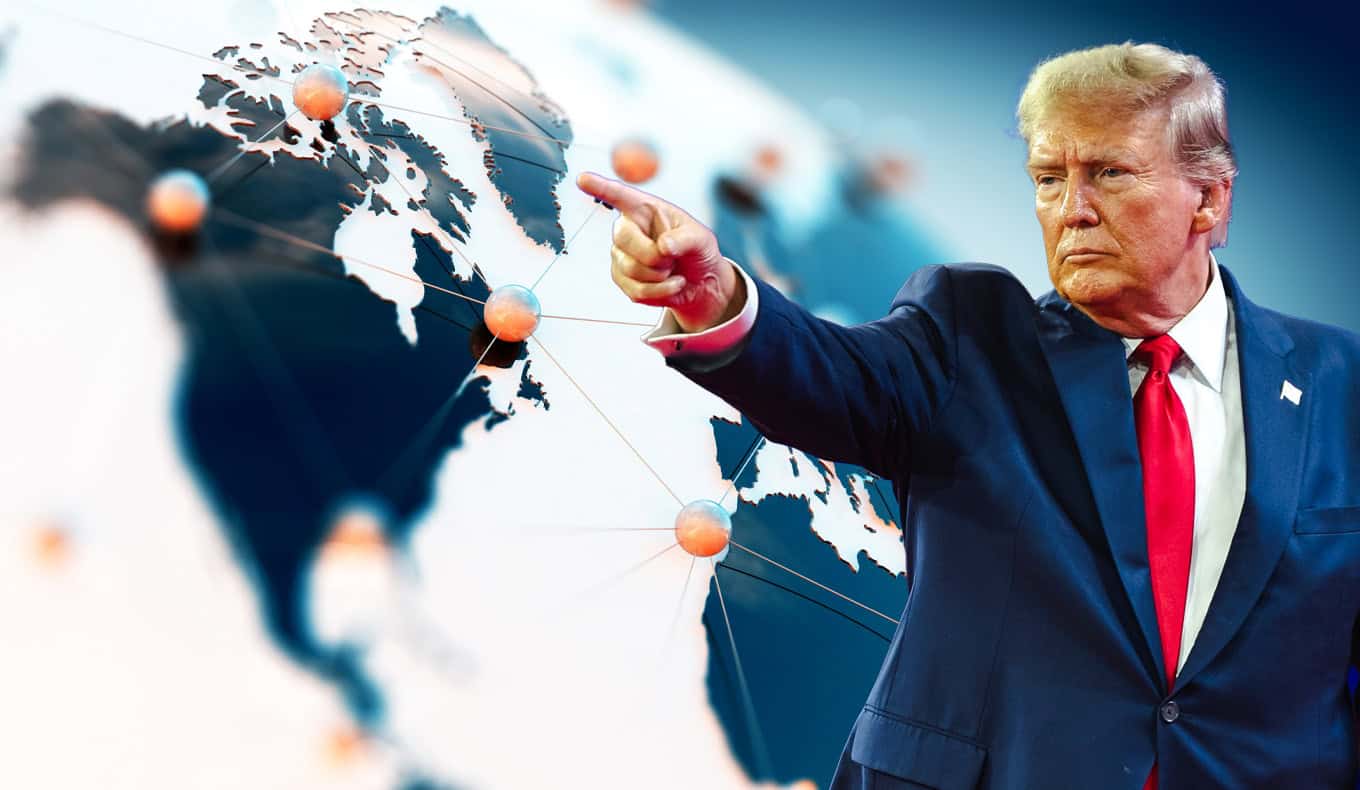

Trump Foreign Policy and Global Power Shift defines a structural confrontation between attempts at restoring American primacy and the accelerating redistribution of global power across multiple centers. The issue is not personality or rhetoric but whether the material distribution of economic capacity, technological control, military reach, and institutional influence still permits a unipolar configuration anchored in the United States. Structural multipolarity is emerging through the rise of China, the resilience of Russia, the strategic autonomy debates inside Europe, and the assertiveness of middle powers. The tension between unilateral primacy and systemic diffusion forms the core of contemporary geopolitics.
Structural Limits of American Primacy
Unipolarity after the collapse of the Soviet Union depended on unmatched American economic scale, military projection, technological leadership, and institutional dominance. That configuration was not solely military; it was institutionalized through alliances and multilateral regimes. The North Atlantic security architecture centered on NATO provided force integration and political cohesion. Trade institutions under the World Trade Organization embedded liberal economic norms. Financial power rested on dollar centrality reinforced by the International Monetary Fund and the global use of U.S. Treasury markets.
Primacy required consent as much as coercion. Allies accepted American leadership because it generated public goods: security guarantees, open markets, liquidity provision, and technological spillovers. That consent lowered balancing incentives. The system functioned because potential rivals lacked comparable economic scale and network reach.
The structural constraint now is distribution of capability. China’s industrial capacity, technological scaling, and export networks rival the United States across critical sectors. India’s demographic mass and digital infrastructure expansion increase its long-term leverage. Russia retains nuclear parity and strategic depth despite economic limits. The European Union collectively equals American economic weight and debates greater defense autonomy. The balance has shifted from concentrated dominance to dispersed capability.
Attempts to reassert unilateral primacy face diminishing returns when material advantages narrow. Tariffs, sanctions, and diplomatic pressure can delay diffusion but cannot reverse the structural rise of alternative power centers. Coercion accelerates counter-coalitions. The system adapts.
Transactional Strategy Versus Institutional Leadership
The shift in American foreign policy orientation under Donald Trump replaced institutional leadership with transactional leverage. Multilateral frameworks were reframed as burdens rather than strategic multipliers. The logic emphasized bilateral negotiation, cost-sharing demands, and tariff enforcement.
Criticism of allied burden-sharing targeted NATO’s spending gaps, arguing that American taxpayers subsidized European security. Simultaneously, skepticism toward global trade regimes framed the WTO dispute settlement system as constraining U.S. sovereignty. Withdrawal from trade initiatives reduced Washington’s agenda-setting power in rule formation. A leadership model based on pressure rather than institutional embedding reduces alliance cohesion.
Institutional leadership magnifies power through coordination. Transactional bargaining narrows cooperation to short-term gains. When allies perceive unpredictability, hedging increases. Strategic autonomy discourse in Europe intensified partly because uncertainty regarding U.S. commitments forced reassessment of dependence.
China exploited institutional gaps by expanding its economic diplomacy and development financing through mechanisms such as the Belt and Road Initiative. That initiative did not replace Western institutions but diversified options for infrastructure funding. Diversification reduces monopoly leverage.
The structural effect is not immediate displacement but layered competition. When the dominant power questions the legitimacy of its own institutional architecture, others expand parallel arrangements. Institutional fragmentation reinforces multipolar diffusion.
Technology Rivalry and Supply Chain Reordering

The central axis of power competition lies in technology control. Semiconductor manufacturing, artificial intelligence development, quantum research, and telecommunications infrastructure determine long-term strategic leverage. American export controls on advanced chip technologies seek to restrict Chinese access to high-end manufacturing equipment. Technology denial functions as containment.
However, technology ecosystems operate through globalized supply chains. Restrictive policies incentivize indigenous development in targeted states. China accelerates semiconductor localization; European and Asian states seek supply diversification to reduce vulnerability to U.S.–China rivalry.
The weaponization of interdependence changes strategic calculus. Financial sanctions, export controls, and investment screening transform economic integration into geopolitical instruments. This transformation reduces trust in global supply stability. Firms relocate production to politically aligned jurisdictions, producing friend-shoring dynamics.
Yet fragmentation imposes cost. Global growth slows when duplication replaces specialization. Competing standards in digital governance and data regulation produce parallel technological spheres. The competition between American platform ecosystems and Chinese digital infrastructure models reflects divergent governance philosophies.
American dominance in foundational technologies remains substantial, but its ability to enforce global uniformity declines as alternatives mature. Multipolarity in technology emerges not from parity but from redundancy and partial decoupling.
Energy Politics and Strategic Leverage on Trump Foreign Policy
Energy markets illustrate the limits of coercive dominance. Sanctions targeting Russian energy exports aimed to degrade revenue streams and strategic capacity. However, global energy demand reallocated flows toward Asia and the Global South. Price caps and embargoes altered trade routes but did not eliminate Russian participation in global markets.
Simultaneously, the United States leveraged its role as a liquefied natural gas exporter to Europe. Energy interdependence became a strategic instrument rather than a neutral commodity exchange. Middle Eastern producers diversified diplomatic alignments, balancing relations with Washington and Beijing.
The enlargement of BRICS expanded the political visibility of non-Western coordination. Although BRICS lacks institutional cohesion comparable to NATO or the European Union, it signals dissatisfaction with Western-centric financial governance. Discussions about alternative payment systems and local currency trade settlements challenge dollar centrality incrementally rather than abruptly.
Dollar dominance persists due to liquidity depth, legal predictability, and network effects. Yet incremental diversification reduces exclusivity. Financial multipolarity develops gradually through regional arrangements, not sudden collapse.
Middle Powers and Strategic Autonomy
Multipolar diffusion is reinforced by middle powers pursuing flexible alignments. India cooperates with the United States in security frameworks such as the Quadrilateral Security Dialogue while maintaining energy and defense ties with Russia. Turkey leverages NATO membership while engaging in independent regional interventions. Gulf states diversify arms procurement and diplomatic engagement.
Strategic autonomy reflects rational adaptation to uncertainty. When hegemonic guarantees appear conditional, states hedge. Hedging reduces binary bloc formation. The system evolves toward issue-based coalitions rather than fixed ideological camps.
European debates about defense integration and industrial policy represent structural recalibration. Collective economic capacity gives Europe leverage, yet fragmentation persists in foreign policy coordination. The pursuit of technological sovereignty through industrial subsidies indicates recognition of vulnerability to external shocks.
Multipolarity does not imply equality; it implies plural centers of decision-making authority. The diffusion of veto power across actors complicates collective action on climate governance, trade liberalization, and security stabilization.
Security Architecture Under Strain
American primacy historically provided deterrence stability through extended nuclear guarantees and forward deployment. When credibility is questioned, regional security dilemmas intensify. East Asian states reassess contingency planning regarding Taiwan. European states reconsider defense procurement and readiness.
Rival powers test boundaries when deterrence signals appear inconsistent. Yet overextension risks domestic backlash within the United States. Foreign policy polarization constrains long-term strategy continuity. Allies evaluate not only current leadership but also electoral volatility.
Security competition increasingly intersects with economic domains. Cyber operations, infrastructure sabotage, and space capabilities blur civilian-military distinctions. The domain of contest expands beyond traditional battlefields.
The strategic challenge for any attempt to restore unipolar dominance is that coercion generates balancing. Realist theory predicts counter-coalitions when a state seeks overwhelming primacy. Liberal institutionalism argues that cooperative frameworks mitigate balancing by embedding leadership within shared norms. Abandonment of embedding accelerates structural resistance.
Economic Nationalism and Global Fragmentation

Economic nationalism under tariff regimes aimed to correct trade imbalances and reshore manufacturing. Tariffs function as leverage but also as taxation on domestic consumers and firms. Retaliatory measures fragment supply chains.
Industrial policy resurgence in multiple states reflects recognition that strategic sectors cannot rely solely on market efficiency. Semiconductor subsidies in the United States, state-led investment in China, and green industrial packages in Europe indicate convergence toward strategic state intervention.
Convergence reduces the ideological distinction between liberal and state-capitalist models. Competition shifts from ideological export to technological execution capacity. Efficiency yields to resilience.
Global trade volumes continue, but patterns regionalize. North American integration deepens; Asian trade networks intensify; Europe recalibrates dependencies. Globalization persists in segmented clusters rather than uniform expansion.
Information Order and Narrative Competition
Power competition now includes narrative control. Competing media ecosystems shape perceptions of legitimacy. Social media platforms amplify geopolitical messaging. Disinformation campaigns erode trust in democratic institutions.
American soft power historically derived from cultural influence, higher education attraction, and normative leadership. Perceived inconsistency between rhetoric and action weakens persuasive authority. When domestic polarization becomes visible, credibility declines abroad.
China promotes development-focused narratives emphasizing sovereignty and non-interference. Russia frames Western expansion as destabilizing. Competing narratives seek alignment from the Global South.
Narrative competition does not determine outcomes alone but conditions diplomatic alignment. Legitimacy affects coalition durability.
Military Balance and Strategic Risk
Despite global power diffusion, Trump foreign policy operates within a system where the United States still retains unmatched military reach, carrier strike capacity, and entrenched alliance networks. Nuclear deterrence continues to function primarily as a bipolar balance between Washington and Moscow, even as Beijing expands its arsenal, leaving overall military asymmetry tilted toward the United States.
At the same time, Trump foreign policy confronts increasingly effective regional denial capabilities. Anti-access strategies, hypersonic weapons development, and advanced cyber operations complicate force projection and raise the operational cost of maintaining dominance.
A strategy of hard primacy under Trump foreign policy would demand persistent defense expenditure, strict alliance management, and rapid technological advancement. Yet domestic fiscal pressure and political polarization challenge long-term sustainability. Structural multipolarity does not erase American superiority, but it constrains unilateral freedom of action.
Financial Architecture and Dollar Centrality
The dollar’s role in global reserves and trade settlement grants sanction leverage. Freezing sovereign reserves signaled willingness to weaponize financial dominance. That action increased perceived risk among states wary of political exposure.
Alternative payment systems develop slowly. Regional arrangements and bilateral currency swaps expand but do not replicate dollar liquidity depth. Trust in U.S. legal institutions and capital market transparency sustains centrality.
Incremental diversification reduces absolute dependence without collapsing the system. Financial multipolarity thus manifests as margin erosion rather than displacement.
Domestic Constraints and Strategic Continuity
Foreign policy capacity depends on domestic consensus. Trade policy shifts, immigration debates, and fiscal disputes reflect internal fragmentation. Electoral volatility signals policy reversibility. Allies account for continuity risk.
Strategic competitors exploit perceived inconsistency. Long-term containment or primacy strategies require sustained bipartisan commitment. Without coherence, oscillation undermines credibility.
The structural transition toward multipolarity interacts with domestic polarization. A state divided internally struggles to impose systemic order externally.
Synthesis of Systemic Trajectory
Restoration of strict unipolarity under Trump foreign policy would require an overwhelming concentration of economic, technological, and military superiority alongside durable alliance cohesion and institutional legitimacy. Current conditions instead reflect distributed capabilities, the rise of alternative institutions, technological fragmentation, and diversified diplomatic alignments.
Efforts at coercive restoration associated with Trump foreign policy tend to accelerate balancing behavior among other states. Transactional diplomacy narrows coalition durability, while institutional retreat weakens agenda-setting authority. Structural diffusion continues regardless of rhetoric.
Multipolarity, in the context navigated by Trump foreign policy, does not signify decline but redistribution. The United States remains the most powerful individual actor, yet it operates within constraints imposed by peer and near-peer competitors. The central strategic choice is adaptation versus restoration: adaptation accepts diffusion and embeds leadership within coalitions, while restoration pursues singular dominance and risks counteralignment.
The trajectory indicates competitive multipolarity characterized by overlapping coalitions, technological bifurcation, economic regionalization, and selective institutional cooperation. Absolute dominance is structurally improbable under current distributions of capability.
Trump Foreign Policy and Global Power Shift encapsulates the friction between aspirational primacy and systemic redistribution. The system moves according to material power diffusion, not rhetorical assertion.